The GLOW Stack: GHK-Cu, BPC-157, and TB-500 for Skin & Recovery

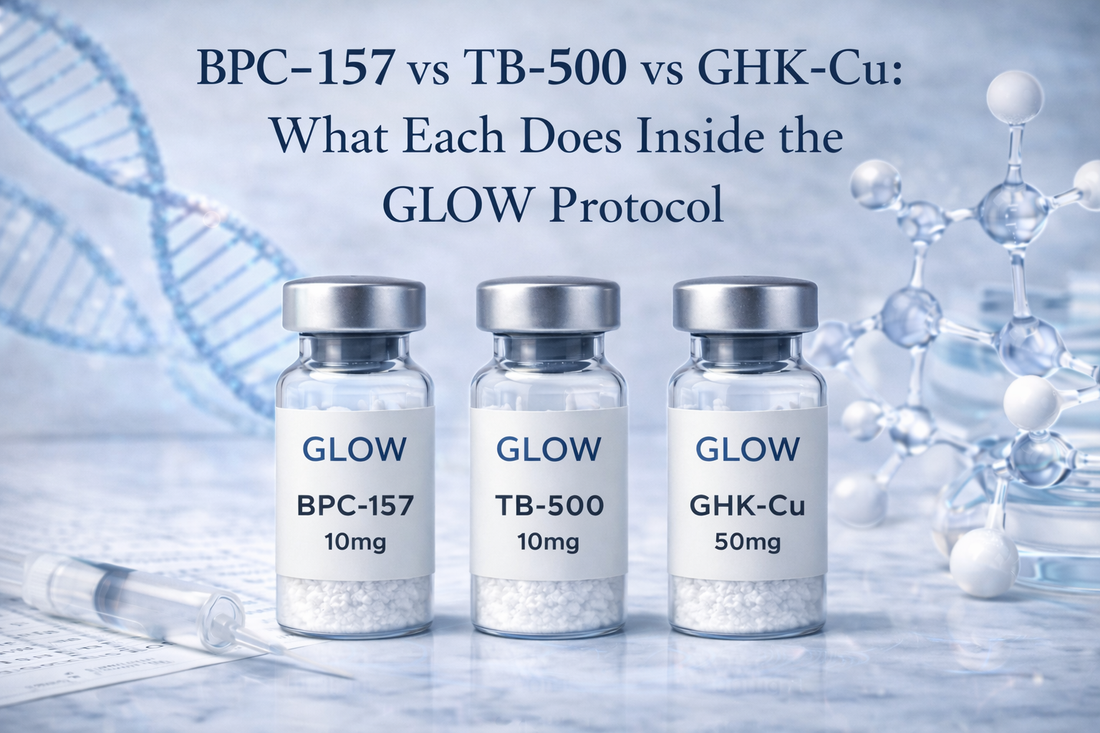
If you've been following peptide trends, you've likely heard of the "GLOW Stack"—a three-peptide combination that's generated significant buzz in wellness, aesthetics, and recovery circles. Combining GHK-Cu, BPC-157, and TB-500, this protocol is marketed as a comprehensive approach to skin rejuvenation, tissue repair, and overall vitality.
But what does the science actually say? Is this combination backed by evidence, or is it more hype than substance? This guide breaks down everything you need to know about the GLOW Stack—its components, proposed benefits, safety considerations, and what the research actually supports.
What Is the GLOW Stack?
The GLOW stack is a research-community shorthand for combining three peptides—BPC-157, TB-500, and GHK-Cu—in a single protocol. Unlike a branded product or standardized clinical therapy, "GLOW Stack" refers to a general approach to peptide combination therapy that has become popular in wellness and aesthetic medicine circles.
As one medical practice explains: "The Glow Stack is a triple-peptide combination therapy that combines GHK-Cu, BPC-157, and TB-500 in a single vial. It targets skin rejuvenation, tissue healing, and anti-aging through three complementary mechanisms—collagen synthesis, angiogenesis, and cell migration".
The name derives from the aesthetic outcomes users report—improved skin radiance, firmness, and an overall "glowing" appearance that develops over weeks of consistent use.
Important clarification: The GLOW stack is not an FDA-approved drug or a standardized clinical therapy. Supplier blends use different ratios, and the combination has never been tested as a fixed three-peptide product in a human trial.
The Three Components: What Each Peptide Does
GHK-Cu (Copper Peptide)
GHK-Cu is a naturally occurring copper-binding tripeptide found in human plasma, saliva, and urine. Its biological role involves facilitating copper uptake into cells, which activates regenerative and anti-inflammatory processes.
Key research findings:
Collagen stimulation: GHK-Cu stimulates collagen and glycosaminoglycan synthesis in skin fibroblasts, supporting skin elasticity and firmness
Gene modulation: It modulates over 31% of genes involved in tissue remodeling
Age-related decline: Plasma levels of GHK decline significantly with age, corresponding with decreases in skin elasticity and wound healing capacity
Evidence base: Multiple controlled topical trials have reported improvements in collagen synthesis and skin density compared with vehicle, vitamin C, or retinoic acid creams. Almost all of the human GHK-Cu evidence is topical, not injectable.
BPC-157 (Body Protective Compound-157)
BPC-157 is a synthetic peptide derived from a protein found in human gastric juice. It has one of the deepest animal research libraries in the peptide world—and one of the shallowest human ones.
Key research findings:
Animal studies: Rodent studies since the 1990s have shown accelerated healing in tendon, ligament, muscle, gut lining, and blood vessel injury models
Human evidence: No randomized human trial of BPC-157 has been published as of mid-2026
Regulatory change: In April 2026, the FDA removed BPC-157 from Category 2 bulk substances list, reopening compounding pathways for licensed pharmacies
TB-500 (Thymosin Beta-4 Fragment)
TB-500 is a synthetic version of a fragment of thymosin beta-4, a 43-amino-acid protein found in nearly every human cell. It binds and regulates actin, which cells use to move, divide, and rebuild tissue after injury.
Key research findings:
Cell migration: TB-500 helps direct cells to injury sites
Human trials: The parent protein, thymosin beta-4, has reached human trials for conditions like dry eye disease, but the fragment used in wellness protocols has not been validated for musculoskeletal healing in humans
Animal reputation: TB-500 built its reputation in racehorses before crossing into human wellness circles
How the Three Work Together
The logic of the GLOW Stack is layered repair:
| Component | Primary Role |
|---|---|
| GHK-Cu | Signals collagen production and supports tissue remodeling |
| BPC-157 | Supports blood supply (angiogenesis) to healing tissue |
| TB-500 | Helps cells migrate into the repair zone |
Each mechanism has been demonstrated in laboratory settings. However, as one analysis notes: "Whether combining them produces additive results in humans is untested".
GLOW vs. Wolverine Stack
A common question is how the GLOW Stack differs from the Wolverine Stack. The Wolverine stack uses two peptides—BPC-157 and TB-500—and is typically framed around tissue repair. The GLOW stack adds GHK-Cu, making it essentially "Wolverine plus a collagen and skin-density layer".
Reported Benefits
The GLOW stack is associated with both aesthetic and recovery-focused outcomes:
Skin & Aesthetics
Improved skin firmness, elasticity, and tone
Enhanced collagen and elastin production
Reduction in fine lines and wrinkle depth
Support for hair and nail health
Recovery & Healing
Tissue repair support (tendon, ligament, muscle)
Inflammation reduction
Post-procedure healing support
Wound healing acceleration
Timeline
Healing and anti-inflammatory effects are often noticeable within 1-3 weeks. Skin and anti-aging benefits typically develop over 4-8 weeks as collagen remodeling takes time. Full therapeutic benefit usually develops over 8-12 weeks of consistent use.
Dosing and Administration
Critical note: There is no clinically validated dose for the GLOW blend. Protocols come from compounding pharmacy conventions and practitioner habits.
Typical patterns observed in wellness clinics:
| Component | Common Daily Dose | Schedule |
|---|---|---|
| GHK-Cu | 1–2 mg | 5–7 days per week |
| BPC-157 | 250–500 mcg | 5–7 days per week |
| TB-500 | 2–2.5 mg | Twice weekly |
Administration: Injections are subcutaneous, usually in the abdomen or thighs.
Cycling: A common approach involves:
8–12 weeks of use
Followed by 2–4 weeks off
This is intended to prevent desensitization—though this is based on clinical convention, not published studies.
Safety and Side Effects
Reported Side Effects
The GLOW stack shows what practitioners describe as a favorable safety profile when prescribed and monitored by a medical professional. Common side effects are typically mild:
Injection site redness or irritation
Temporary fatigue during the first phase of treatment
Occasional nausea or headache
Important Safety Considerations
Theoretical risks discussed in the literature include:
Angiogenesis concerns: The angiogenesis-promoting properties of BPC-157 and TB-500 have been flagged as a theoretical concern in patients with active malignancy
Immunogenicity: The FDA has cited immunogenicity concerns for compounded peptide bulk substances
Unknown combined safety: The combination has never been tested as a fixed three-peptide product in a human trial
Who Should Avoid the GLOW Stack
Patients with active cancer
Severe kidney or liver dysfunction
Pregnancy or breastfeeding
Copper sensitivity or Wilson's disease
The Regulatory Gap
As one analysis states: "The greatest risk usually comes from unregulated sources". Products purchased online through unregulated suppliers carry significant risks regarding purity, sterility, and dosing consistency.
The Evidence Gap
It's important to understand what the evidence actually supports—and what it doesn't.
What We Know
GHK-Cu has controlled topical trials supporting collagen synthesis and skin density improvements
BPC-157 has extensive animal research but no randomized human trials
TB-500 has human trials of the parent protein (thymosin beta-4) but not for the specific use case in GLOW protocols
What We Don't Know
Whether the GLOW combination produces additive results in humans
Long-term safety data for any of these peptides
Optimal dosing ratios or protocols
Combined safety data for the three peptides together
As one peer-reviewed review in Frontiers in Aging emphasizes: "The investigational peptides discussed in this review are not approved by the FDA... and the available evidence is insufficient to constitute clinical guidance".
Regulatory Status (2026 Update)
Regulatory status changed materially in April 2026:
As of April 22, 2026, the FDA removed BPC-157, TB-500, and injectable GHK-Cu from 503A Category 2 (the list of bulk drug substances flagged for significant safety concerns in compounding)
The Pharmacy Compounding Advisory Committee is scheduled to review BPC-157 and TB-500 on July 23, 2026
GHK-Cu review is anticipated before February 2027
This removal does not equal FDA approval—it reopens compounding pathways for licensed pharmacies.
Frequently Asked Questions
Q: What is the GLOW peptide stack?
A: The GLOW stack is a research-community shorthand for combining three peptides—BPC-157, TB-500, and GHK-Cu—in one protocol. It is not an FDA-approved drug or a standardized clinical therapy.
Q: How is the GLOW stack different from the Wolverine stack?
A: The Wolverine stack uses BPC-157 and TB-500 for tissue repair. The GLOW stack adds GHK-Cu, which brings collagen synthesis and skin rejuvenation to the combination.
Q: Is the GLOW peptide stack FDA-approved?
A: No. As of April 2026, the components were removed from the FDA Category 2 list, but this does not equal approval. The GLOW stack has never been evaluated as a combination product.
Q: How long until I see results?
A: Healing effects from BPC-157 and TB-500 are often noticeable within 1-3 weeks. Skin benefits from GHK-Cu typically develop over 4-8 weeks.
Q: Can I get the GLOW stack from a doctor?
A: Some physicians prescribe peptides through regulated compounding pharmacies. This is legally distinct from purchasing research-grade peptides online.
Q: What are the risks?
A: Risks include contamination from unregulated sources, unknown purity, and unknown long-term effects. Theoretical risks include angiogenesis concerns in patients with active malignancy.