The Sleep Stack: DSIP and Epithalon for Restorative Sleep and Circadian Health

If you've struggled with sleep—difficulty falling asleep, staying asleep, or waking up unrefreshed—you've likely encountered DSIP and epithalon in peptide conversations. These two peptides are frequently discussed as the core of a "sleep stack," promoted for their potential to improve sleep architecture and reset circadian rhythms.
But what does the science actually support? Are these peptides proven sleep solutions, or is the evidence thinner than marketing claims suggest? This guide examines the research, the gaps, and what you should know before considering these peptides.
What Is a Sleep Stack?
A sleep peptide stack typically pairs DSIP (delta sleep-inducing peptide) with epithalon (also spelled epitalon), sometimes with supporting compounds like glycine, magnesium, or melatonin added. The logic behind stacking is that sleep isn't one process—it involves sleep pressure (how sleepy you feel), circadian timing (when your body expects sleep), and sleep architecture (how much deep and REM sleep you get). A stack aims to nudge more than one of these at once .
The honest caveat? Whether this works better than a single agent has not been tested in any large trial. Most protocols are based on practitioner anecdotes rather than rigorous clinical data .
DSIP: The Delta Sleep Peptide
What Is DSIP?
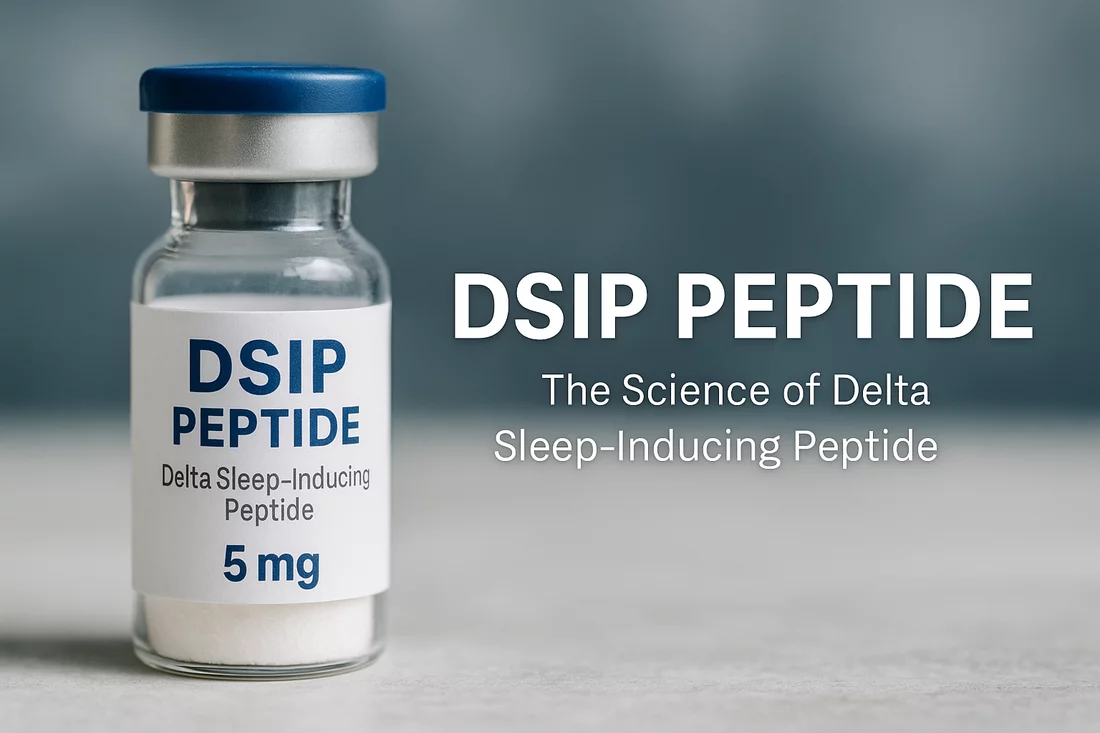
DSIP (delta sleep-inducing peptide) is a nine-amino-acid peptide first isolated from rabbit brain by researchers Schoenenberger and Monnier in 1977. They named it for its apparent ability to promote delta-wave (deep) sleep when infused into other animals .
What the Research Shows
Here's the catch: the data after that initial discovery has been inconsistent. Some small human studies in the 1980s suggested DSIP might help with sleep disturbances and pain, but other studies found no reliable effect on sleep architecture. A frequently cited limitation is that DSIP does not behave like a simple sedative, and its blood levels do not track neatly with sleep stages .
The honest read: DSIP is genuinely studied, but it never became a mainstream sleep treatment because the results never held up consistently. If someone tells you DSIP is a proven deep-sleep peptide, the literature does not support that confidence .
Epithalon: The Circadian Rhythm Peptide
What Is Epithalon?
Epithalon (also spelled epitalon) is a four-amino-acid peptide (Ala-Glu-Asp-Gly) developed from a pineal extract called epithalamin. Most of the research comes from Professor Vladimir Khavinson and colleagues in St. Petersburg, who studied it for aging and circadian function .
Epithalon is often discussed in longevity circles because it has been shown to activate the telomerase enzyme in cell culture, potentially reducing telomere shortening .
The Sleep Connection
The sleep angle is indirect. The pineal gland makes melatonin, and some of Khavinson's work reported that epithalamin and epithalon influenced melatonin secretion and restored more youthful circadian patterns in older animals and small human groups .
The important caveat: Most of this research is from a single research lineage, much of it in Russian journals, and large independent replication is missing. The melatonin and circadian findings are interesting but not confirmed by Western regulatory-grade trials .
The Khavinson Protocol
For longevity purposes, the "Khavinson Protocol" involves: 5–10mg, 3x per week for 3 weeks, cycled 1x per year . For sleep-focused protocols, some practitioners suggest shorter courses of 10-20 days rather than year-round daily use .
How Do People Structure a Sleep Stack?
In practice, protocols vary because there is no standardized, evidence-based dosing .
Common patterns observed in wellness circles:
| Component | Typical Use | Notes |
|---|---|---|
| DSIP | Evening dosing, often nasal or subQ | Microgram range; inconsistent evidence |
| Epithalon | Short cycles (10-20 days) | Often 1-5mg daily during cycle |
| Magnesium Glycinate | 400mg, 1 hour before bed | Well-studied for relaxation |
| Glycine | 2-3g before bed | Small randomized studies support improved sleep quality |
User reports suggest that some individuals find the DSIP and epithalon combination effective, with the DSIP helping with sleep onset and the epithalon providing longer-term circadian benefits .
However, one sleep stack user notes that they found benefits from DSIP alone, while another found that adding epithalon and pinealon provided an "equal boost in REM sleep" .
Supporting Compounds That Actually Have Evidence
A lot of what makes a "sleep stack" feel like it works is the well-studied stuff layered alongside the peptides :
Melatonin (0.5-3mg) has the most human data for circadian timing, especially for jet lag and delayed sleep phase
Glycine (about 3g before bed) has small randomized studies suggesting improved subjective sleep quality
Magnesium glycinate is popular for muscle relaxation and sleep support
Safety and Important Considerations
The Quality Problem
A significant concern is the variability in peptide quality. Self-dosing research peptides bought online carries real safety risks—both because the products may not be what the label says and because there is no medical oversight .
The Foundation First Principle
A responsible provider will usually start by ruling out treatable causes of poor sleep first. Sleep apnea, untreated anxiety, shift work, and alcohol are far more common reasons for bad sleep than any peptide can fix .
The evidence-based basics carry the most weight:
Consistent sleep schedule
Avoiding caffeine and alcohol before bed
Managing stress and anxiety
Treating underlying sleep disorders
Regulatory Status
Peptides like DSIP and epithalon are not FDA-approved drugs and are not legal dietary supplements. In a medical setting, certain peptides are accessed through 503A compounding pharmacies, which prepare individualized prescriptions when a licensed provider determines it is appropriate. This is different from buying "research" products online .
Frequently Asked Questions
Q: Is DSIP proven to improve sleep?
A: No. The data on DSIP has been inconsistent since its discovery in 1977. Some small studies suggested benefits, but others found no reliable effect on sleep architecture .
Q: What is epithalon's role in sleep?
A: Epithalon influences melatonin secretion and circadian rhythms, according to research from a single Russian research group. Independent replication is missing .
Q: Can I use DSIP and epithalon together?
A: Yes, this is the most common sleep peptide stack. However, whether the combination works better than either alone has not been tested in any large trial .
Q: How long does it take to see results?
A: User reports vary. Some individuals notice benefits within days, while others find that consistent use over weeks is needed .
Q: Are sleep peptides legal?
A: DSIP and epithalon are not FDA-approved drugs and are not legal dietary supplements. They may be accessed through compounding pharmacies with a prescription .