The Science of GHK-Cu: How This Copper Peptide Supports Skin, Hair, and Healing

If you’ve been researching peptides for skin health, hair support, or tissue repair, you’ve likely come across GHK-Cu – often called the "copper peptide." It’s one of the most researched and talked-about peptides in the wellness and aesthetic space.
But what actually is GHK-Cu? Does the science back up the claims? And what should you know before incorporating it into your routine?
This guide answers all of those questions, drawing on published research and clinical observations to give you a clear picture of what GHK-Cu does and how it works.
What Is the science of GHK-Cu?
GHK-Cu (glycyl-L-histidyl-L-lysine copper) is a naturally occurring tripeptide—a chain of three amino acids—bound to a copper ion. It’s not a synthetic lab creation; your body already produces it. GHK-Cu circulates in your plasma and is present in saliva and various tissues.
First isolated in the 1970s, GHK-Cu has been the subject of decades of research for its role in cellular signaling and tissue maintenance.
Here’s the catch: as you age, your body’s natural GHK-Cu production declines significantly. Levels peak early in life and drop off substantially over time. This decline correlates with visible changes in skin elasticity, texture, and overall tissue repair capacity—which is why GHK-Cu has attracted so much attention from researchers and practitioners.
How Does GHK-Cu Work?
GHK-Cu exerts its effects at the genetic level—it influences gene expressionrather than just providing surface-level benefits.
1. Anti-Inflammatory & Antioxidant Actions
One of GHK-Cu’s most significant systemic benefits is its ability to downregulate inflammation at the genetic level. Research shows that GHK-Cu inhibits the expression of multiple pro-inflammatory cytokines, including tumor necrosis factor-alpha (TNF-α) and various interleukins associated with chronic inflammatory states.
This is meaningfully different from standard immune suppression. GHK-Cu helps resolve excess inflammation—a phenomenon researchers increasingly identify as a primary driver of accelerated aging, metabolic disease, and tissue degeneration.
On the antioxidant side, GHK-Cu increases the activity of superoxide dismutaseand other free-radical scavenging enzymes while reducing lipid peroxidation. This dual action—reducing inflammation and oxidative stress—makes GHK-Cu a compelling candidate for longevity and tissue health strategies.
2. Collagen Synthesis & Remodeling
The most well-studied effect of GHK-Cu is its role in collagen production. Multiple controlled topical trials have reported improvements in collagen synthesis and skin density compared to vehicle, vitamin C, or retinoic acid creams.
In the GLOW stack context, GHK-Cu is the component most associated with skin-quality and matrix-remodeling research.
Key Benefits of GHK-Cu
For Skin Health
GHK-Cu’s benefits for skin center on firmness and texture. Studies suggest the peptide supports the appearance of firmer, smoother-looking skin and may help improve the appearance of fine lines with consistent use. Pairing GHK-Cu with complementary signal peptides may amplify these results.
For Hair
GHK-Cu has demonstrated promising results in early-stage hair research. It's been studied for supporting thicker-looking hair and reducing scalp discomfort.
Beyond Skin & Hair
Researchers are also exploring GHK-Cu’s effects on the nervous system. Several studies have investigated its neuroprotective properties, including the ability to reduce oxidative damage in neuronal cells and modulate gene expression pathways associated with cognitive decline.
There is also emerging evidence around lung tissue repair, with GHK-Cu showing measurable results in tissue remodeling studies following damage. Its influence on gene expression across multiple organ systems suggests it functions as a broad biological repair signal rather than a tissue-specific compound.
What Is the GLOW Stack and How Does GHK-Cu Fit In?
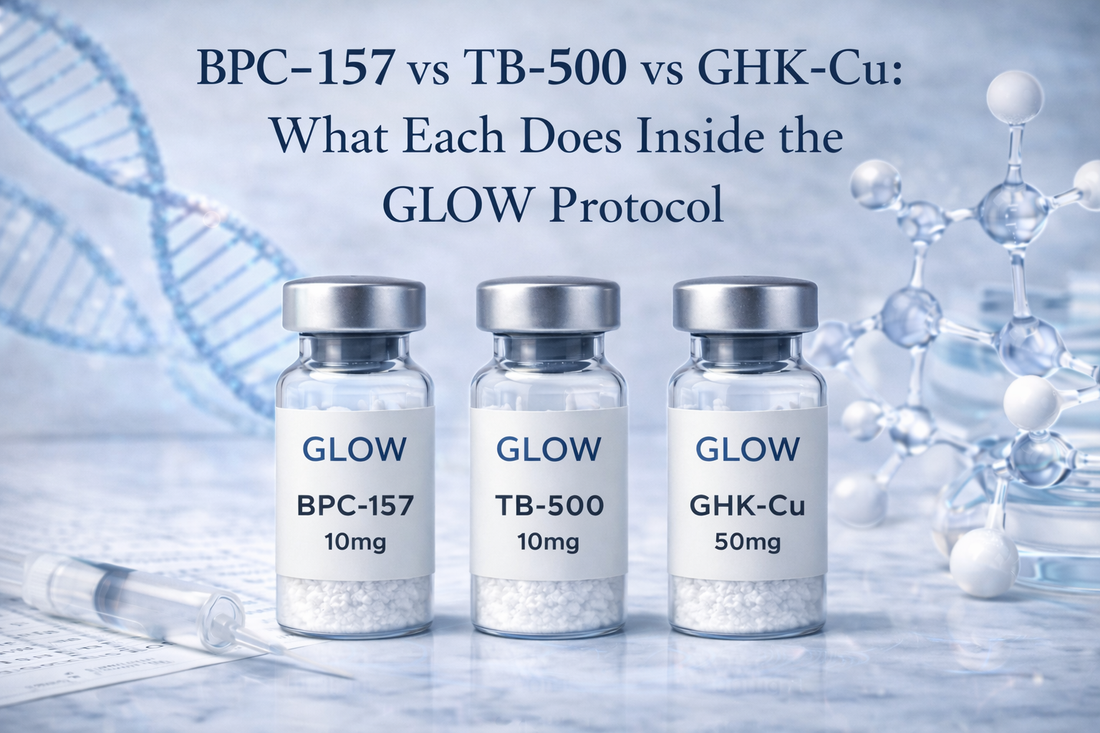
The GLOW stack is a research-community shorthand for combining three peptides—BPC-157, TB-500, and GHK-Cu—in a single protocol.
⚠️ Important: The GLOW stack is not an FDA-approved drug or a standardized clinical therapy. The combination has never been tested as a fixed three-peptide product in a human trial. Suppliers sell pre-blended GLOW vials, but ratios vary, and these products are sold as research chemicals, not validated treatments.
How the Three Peptides Work Together (In Theory)
The logic of the stack is layered repair:
GHK-Cu: Signals collagen production and supports skin quality
BPC-157: Supports blood supply to healing tissue (based on animal studies)
TB-500: Aids cell migration into the repair zone (based on animal and veterinary research)
Each mechanism is real in laboratory settings, but whether combining them produces additive results in humans is untested.
GLOW vs. Wolverine Stack
The Wolverine stack uses two peptides, BPC-157 and TB-500, and is usually framed around tissue repair. GLOW adds a third peptide, GHK-Cu, so it's essentially Wolverine plus a collagen and skin-density layer.
How to Use GHK-Cu: Topical vs. Injectable
Topical Application
Topical GHK-Cu is widely used in cosmetics and is the delivery method with the most human evidence.
Concentration: The most commonly studied concentrations range from 0.1% to 2%. Products in the 0.5% to 1% range offer a practical balance of efficacy and tolerability for most users.
Timing: GHK-Cu degrades when combined with highly acidic ingredients, particularly high-dose vitamin C. A morning vitamin C routine followed by an evening GHK-Cu serum avoids this interaction and is the approach most widely recommended by dermatologists.
Serum vs. Cream: Serums generally offer better dermal penetration due to lower molecular weight carriers. Creams can maintain skin barrier function but are less suited for users seeking measurable results within a defined timeframe.
Injectable GHK-Cu
Subcutaneous injection of GHK-Cu is used in peptide therapy clinics under physician supervision. Injectable forms bypass the skin barrier and enter systemic circulation.
⚠️ Critical Safety Note: Any injectable protocol must be individualized and managed by a qualified practitioner. The injectable form requires a prescription from a licensed healthcare provider in the United States.
How to Choose a Quality GHK-Cu Product
If you're sourcing GHK-Cu for research or considering it for personal use, quality matters significantly:
Look for Independent Verification: Source only from suppliers that provide certificates of analysis from independent third-party labs.
Check Storage: Lyophilized (freeze-dried) GHK-Cu powder should be stored at 2 to 8°C (refrigerated), away from direct light.
Avoid Acidic Mixes: For topical serums, avoid formulas that combine GHK-Cu with high-concentration vitamin C in the same bottle—they degrade each other.
Safety Profile
GHK-Cu has one of the most favorable tolerability profiles in the peptide research space.
Topical Use
Topical application is associated with minimal adverse effects. Occasional mild skin irritation or redness has been reported at higher concentrations in very sensitive skin types, but this typically resolves with reduced application frequency.
What the Research Tells Us
Across the three compounds (GHK-Cu, BPC-157, TB-500), the most consistently reported observation in published trials is mild, local, transient effects—for example, injection-site reactions. Systemic toxicity has not been observed at standard protocol concentrations
Frequently Asked Questions
Q: Is GHK-Cu FDA-approved?
A: No. GHK-Cu is not an FDA-approved drug. Topical GHK-Cu is widely used in cosmetics and skincare products. Injectable GHK-Cu requires a prescription from a licensed healthcare provider.
Q: How long does it take to see results from GHK-Cu?
A: With topical application, visible improvements typically develop within 6-8 weeks of consistent daily use.
Q: Can I use GHK-Cu with vitamin C?
A: Not in the same application. Use vitamin C in the morning and GHK-Cu in the evening to avoid degradation of the peptide.
Q: What’s the difference between GHK-Cu and AHK-Cu?
A: GHK-Cu carries the deeper research profile by a wide margin. Most published studies referencing copper peptides are referring to GHK-Cu, not AHK-Cu.
Important Disclaimers
⚠️ The information in this article is for educational and research purposes only.
🚫 This is not medical advice. This article does not diagnose, treat, or prescribe any treatment. Peptides mentioned are not FDA-approved for the uses discussed.
👨⚕️ Consult a licensed healthcare provider before making any decisions regarding peptide use, hormone modulation, or any other intervention discussed in this article.
🧪 Products discussed are intended for research purposes only unless prescribed by a licensed healthcare provider. Self-administration of peptides outside a physician-supervised setting carries real risks, including risks not captured by the available data